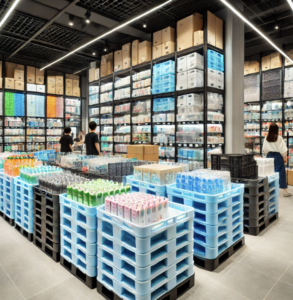
Retail looks simple from the front of the store. Products arrive, shelves stay stocked, customers buy, and the day moves on. Behind that smooth experience is a nonstop flow of inventory that has to be handled, staged, counted, moved, stored, and replenished with speed and accuracy. When that flow gets choppy, the store pays for it fast through damaged goods, late replenishment, messy backrooms, safety incidents, out-of-stocks, and labor that gets burned up doing the same work twice.
That is why retail stores benefit from working with a Plastic Pallet Company. Pallets are not just shipping platforms. They are a repeat-use asset that touches nearly every part of modern retail operations, from distribution to reverse logistics. Partnering with the right plastic pallet provider helps retailers protect product, stabilize replenishment, improve hygiene, cut downtime, support automation, and build a cleaner, more predictable supply chain.
Retail is a supply chain business, even when it feels like a people business
Retail performance is tied to how well inventory moves. Sales depend on availability, assortment, speed-to-shelf, and keeping costs under control while expectations keep climbing. Official retail sales releases underscore how closely retail outcomes track broader operational realities like inventory flow and fulfillment pressure, not just marketing and merchandising (Monthly Retail Trade – Sales Report).
Pallets sit at the center of that movement because they shape how product is unitized, stored, transported, and staged. A strong plastic pallet partner helps a retailer treat pallets as a managed system rather than a pile of mismatched wood platforms that create friction and waste.
Plastic pallets bring consistency, and consistency is where retail wins
Retail operations run on standardization. Store plans are standardized, shelf sets are standardized, delivery windows are standardized, and labor schedules are standardized. Pallets should be, too.
Plastic pallets offer a consistent footprint and predictable performance across loads, lanes, and seasons. That consistency matters because it reduces the “surprise costs” that show up when pallets vary in quality: leaning stacks, crushed corners, broken boards, and unstable loads that slow down receiving and create product damage. A plastic pallet company can supply a consistent pallet spec across locations, align pallet selection to load profiles, and keep performance uniform across the network.
That uniformity also supports the broader push toward stronger supply chain execution in retail operations coverage and industry reporting (Retail Dive).
Cleaner handling supports cleaner stores and cleaner product movement 🧼
Retailers handle a huge mix of goods, and hygiene is a real operational concern, especially in grocery-adjacent categories, health and beauty, pet, baby, and any product that sits close to consumables. Plastic pallets are easier to clean and sanitize than wood and do not shed splinters or absorb odors the same way.
For stores, this translates to cleaner backrooms, fewer contamination concerns, and less time spent managing messy pallets. It also supports a more disciplined receiving process, where the pallet is not the weak link that introduces dust, debris, or broken wood into product handling zones.
For foundational context on pallets and how they function as a logistics unit, see the overview of pallets as a handling platform (Pallet – Wikipedia).
Fewer damages, fewer incidents, fewer hidden costs
Retail profit is often lost in small amounts, repeatedly. A dented case here, a crushed box there, a broken shrink wrap corner that becomes unsellable after being scuffed in transit or in the backroom. Pallet quality influences all of that.
Plastic pallets reduce common damage triggers:
-
No protruding nails that tear packaging
-
No splintered boards that snag stretch wrap
-
More predictable load stability during handling
-
Better stacking behavior and less pallet “flex” variability when matched correctly to the load
A plastic pallet company can help retailers match pallet design to actual retail use cases such as mixed-SKU store replenishment loads, display-ready pallets, or high-velocity cross-dock movement.
Better fit for modern retail distribution and store replenishment
Retail distribution is not simply bulk movement. It is rapid sorting, store-specific allocation, and frequent handling that prioritizes speed and accuracy. Retail distribution requires breaking down freight, building store-friendly shipments, and moving product through facilities with minimal dwell time. Industry explainers on retail distribution highlight how the work centers on receiving, breaking down pallets, picking, packing, and route-based shipping (Retail Distribution – Logistics Bureau).
Plastic pallets support that environment by reducing the friction points that slow down handling. When inbound pallets are more uniform and reliable, lift operators and receiving teams move faster, loads stay stable, and exceptions decrease.
A plastic pallet company strengthens reverse logistics and returns flows ♻️
Returns are no longer a side task. They are a major operational stream that affects labor, space, customer satisfaction, and margin. Reverse logistics also includes moving unsold seasonal inventory, recalls, recycling, and inter-store transfers.
Plastic pallet programs fit naturally into reverse logistics because they are built for repeated use and closed-loop management. Many pallet companies offer pooling, retrieval, tracking, refurbishment, and lifecycle management services that align with the way retailers increasingly treat returns and circularity as a profit-protection strategy.
Retail-focused thought leadership has been emphasizing reverse logistics as a lever for value recapture and resilience (Beyond retail: The hidden reach of reverse logistics – NRF).
Supports automation, tracking, and the next generation of inventory accuracy
Retailers are investing in better visibility and faster decision-making. That includes scanning, RFID programs, sensor-enabled tracking, and warehouse automation that depends on predictable, machine-friendly load units. Plastic pallets support these investments because they are dimensionally stable and often more compatible with automated systems than inconsistent wood pallets.
A managed relationship with a plastic pallet company makes it easier to standardize pallet types across facilities and stores, which supports smoother automation and fewer jams, misreads, and handling exceptions.
Sustainability improves when pallets are managed as reusable assets
Retailers are under pressure from customers, regulators, and internal cost targets to reduce waste and operate more responsibly. Pallets may not be customer-facing, but they are part of the retailer’s physical footprint. A plastic pallet program can reduce the churn of single-use pallets, improve asset recovery, and support more predictable end-of-life recycling pathways when the pallet provider manages lifecycle planning.
Retail sustainability discussions increasingly point toward circular systems that reduce waste through reuse and reverse logistics (Circularity is redefining supply chains – NRF).
This is not about chasing a trend. It is about cutting the recurring inefficiencies that show up when pallets are treated as disposable.
Reliability matters when supply chains are already under pressure
Even when demand is steady, retail supply chains deal with volatility: disruptions, labor constraints, transportation pinch points, and sudden shifts in buying. That is why retailers keep focusing on resilience and preparedness.
Retail industry organizations continue to emphasize the need for stronger supply chain infrastructure and coordinated planning across the retail ecosystem (Supply Chain Infrastructure – NRF). A pallet program is one of those practical, operational decisions that improves resilience because it reduces preventable problems at the exact points where inventory changes hands.
What a strong plastic pallet partnership actually looks like in retail
Working with a plastic pallet company is not just buying pallets. The best partnerships feel like an operational system with clear rules and support. In practice, retailers benefit most when the pallet company provides:
-
A standardized pallet spec aligned to retail load profiles
-
A replenishment model that keeps stores and DCs supplied without chaos
-
Asset management such as pooling, tracking, retrieval, repair, and reporting
-
Sanitation and quality controls that match category needs
-
End-of-life planning for recycling and responsible disposal
-
Network-level consistency so stores do not become the “dumping ground” for bad pallets
This kind of structure directly supports the retail supply chain priorities leaders have been outlining in industry coverage (What the retail supply chain will look like in 2025 – NRF).
Conclusion: Plastic pallets help retail run smoother, safer, and more predictably ✅
Retail success is built on execution. Clean receiving, fast replenishment, safe backrooms, protected product, and reliable reverse logistics are not glamorous, but they create the shopping experience customers expect. Plastic pallets, managed through a dedicated Plastic Pallet Company, bring consistency where retail needs it most: the daily movement of goods that keeps shelves full and operations calm.
When pallets are treated as a managed, reusable asset instead of a disposable afterthought, retailers reduce damage, improve hygiene, support modern tracking and automation, and build a more resilient supply chain that performs better through every season.