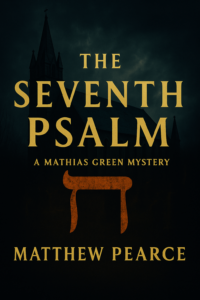
Mystery readers walk into stores looking for a specific feeling: tension they can trust, a lead character they can follow, and a story that keeps tightening its grip until the final page. Retail buyers look for something just as specific: a book with a clean hook, strong hand-sell potential, and shelf presence that turns browsers into buyers. The Seventh Psalm by Matthew Pearce delivers on both sides of that equation, which is why it belongs in the conversation as one of the best new mystery books for retail outlets right now.
At its core, this is a modern, high-concept mystery with a crisp premise that reads like a staff-pick pitch in one breath. A string of ritualistic murders strikes New York City, staged with “theological precision,” and the NYPD turns to Dr. Mathias Green, a former divinity scholar turned criminal profiler, to decode what the killer is communicating through scripture, symbolism, and blood. Mathias is haunted, sharp, and pulled into an escalating case where doctrine becomes a weapon and the killer’s message starts to mirror Mathias’s own past teachings.
A Retail-Ready Premise That Communicates Fast
Retail success starts with clarity. Customers decide in seconds whether a book feels like their kind of story, and the strongest titles make that decision easy. The Seventh Psalm communicates quickly because the hook is instantly legible: a profiler with theological expertise hunts a killer turning scripture into staged murder scenes in New York City.
That hook creates multiple entry points for multiple types of shoppers. Traditional mystery readers get the structured investigation, escalating stakes, and pattern-driven puzzle. Thriller-leaning readers get urgency and a dangerous adversary. Readers drawn to psychological tension get a protagonist with a mind he does not fully trust and a past he refuses to open.
For retail teams, that range matters. It increases the size of the “yes” audience without diluting the brand of the book. It also makes the hand-sell natural. Staff can describe it cleanly to a customer without overexplaining, and customers can repeat the premise to friends without losing the thread.
A Setting and Tone That Match What Mystery Shoppers Buy
New York City remains one of the most reliable backdrops in commercial mystery because it signals scale, complexity, and shadowed institutions. The Seventh Psalm leans into that energy while keeping the investigation grounded in character. Mathias is not positioned as a superhero. He is positioned as a specialist with scars, pulled into a case that forces him into both the city’s underworld and his own.
That tone fits what mystery readers routinely reward: a smart, capable lead who pays a personal price for the truth. It also supports the kind of browsing behavior retailers want. Shoppers gravitate toward books that feel “serious” and “addictive” at the same time, and theological symbolism adds a distinctive flavor without pushing the novel into niche territory.
A Cast Built for Series Momentum and Repeat Purchasing
Retailers benefit when a new title has room to grow. Series momentum drives repeat purchasing, staff familiarity, and steady reorders. The Seventh Psalm introduces a team dynamic that supports that momentum: Mathias Green as the specialist profiler, Captain Julia Halpern as the no-nonsense NYPD anchor, and tech analyst Lennox Rivera as the modern investigative edge.
That trio is retail-friendly because it creates continuity. It also creates easy reader attachment. Customers who like one character tend to come back for the next installment, and retailers tend to see better sell-through when readers feel like they are returning to a cast they already trust.
Why This Title Fits the Retail Moment
Retail is operating in a climate where attention is expensive and shelf space must prove itself. Industry coverage continues to spotlight how quickly consumer behavior shifts across formats and channels, and retailers increasingly win by curating experiences instead of simply stocking inventory. Publications that track these shifts, including Retail Dive, regularly emphasize how merchandising, personalization, and strong storytelling around products influence performance.
Books remain one of the cleanest “discovery” categories in-store because they invite browsing. A mystery novel with a sharp premise functions like a high-performing impulse product with deeper satisfaction. The Seventh Psalm supports that because it has a clear identity and a compelling promise: a puzzle-driven hunt with spiritual symbolism and a haunted lead.
Retail coverage also keeps highlighting how major players invest in both physical presence and experience as they compete for shoppers. Reuters’ ongoing retail and consumer reporting captures this constant push-and-pull between ecommerce convenience and in-store engagement. Reuters’ Retail & Consumer coverage reflects that reality daily, and it reinforces a key point for book retail: the store wins when the product creates a moment.
A mystery novel that can be hand-sold in ten seconds creates that moment.
Merchandising Strength: Where It Displays Well and Why It Moves
The Seventh Psalm is especially easy to place because it can live in multiple retail micro-destinations without confusing the customer:
-
Front table “New & Notable” mystery/thriller sets
-
Staff picks with short, punchy shelf talkers
-
True crime adjacent displays for readers who like investigative intensity
-
Urban noir and psychological suspense cross-shelving
Retailers who follow industry best practices for category planning often rely on trends and shopper patterns surfaced by trade groups and outlets that track retail performance. The National Retail Federation consistently publishes retail-focused insights, and its news ecosystem is one of the most widely referenced hubs in the industry.
For stores that want a clean way to keep staff aware of bigger retail shifts while executing day-to-day merchandising, NRF’s newsletter hub, NRF Retail Newsletters, is a practical reference point.
On the bookstore side, the principle stays the same: a title that is easy to summarize and easy to display tends to earn better conversion from browsers.
Authority, Credibility, and the “Explain-It-to-a-Friend” Factor
Retailers sell confidence. Customers buy what feels assured. The Seventh Psalm reads like a book that knows what it is doing: it promises theological precision, delivers a defined adversary in Psalmist13, and frames the narrative stakes around both the case and Mathias’s past.
That clarity helps staff recommend it with conviction, and it helps customers feel safe buying it as a gift. In the modern retail landscape, gifting behavior remains a major driver for discretionary categories. Retail news outlets and market trackers emphasize the ongoing importance of seasonal moments and curated gifting, which is one reason a mystery novel that looks and sounds giftable remains a reliable bet.
For broader retail context and ongoing industry reporting that supports smarter buying decisions, Chain Store Age is another established source retailers use to keep a pulse on trends and store strategy.
Positioning Notes Retail Buyers Can Use Immediately
Retail teams can position The Seventh Psalm with language that converts without overcomplicating:
-
“A New York City murder case decoded through scripture and symbolism.”
-
“A former divinity scholar turned profiler hunts a killer staging murders like a twisted sermon.”
-
“Psychological suspense with an investigative core and a sharp theological hook.”
This kind of positioning aligns with how shoppers browse and how staff hand-sell. It also aligns with the way retail decision-makers evaluate product-market fit across categories, a topic frequently covered in business and retail reporting like The Wall Street Journal’s retail coverage.
For a baseline definition of what retail is and how retail environments drive purchase behavior through merchandising and presentation, even a simple reference like Wikipedia’s entry on Retail is useful for grounding the mechanics behind why books like this convert well on tables and endcaps.
Conclusion
The Seventh Psalm earns its place as one of the best new mystery books for retail outlets because it checks the boxes that matter most: a premise that sells fast, a tone that matches proven reader demand, a cast built for series momentum, and a distinctive theological edge that makes it stand out without making it hard to recommend.
For retailers who want the best new mystery books with strong hand-sell potential and clear display value, the book’s official page, The Seventh Psalm, provides the clean synopsis and positioning needed to support merchandising and staff training.