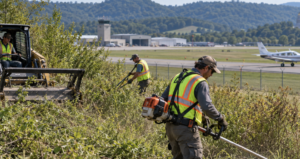
Charleston, West Virginia, is known for its business community, transportation connections, and the infrastructure that supports economic activity throughout the Kanawha Valley. While retail development, commercial investment, and transportation improvements often attract public attention, one essential responsibility receives far less recognition: maintaining the extensive acreage surrounding airports and other transportation facilities.
Large-acreage vegetation management plays an important role in keeping these properties accessible, visible, and manageable. From controlling overgrown grass and brush to maintaining drainage areas, security fence lines, and service roads, professional land maintenance supports the conditions needed for safe and efficient operations.
For property owners and organizations near Mallory Airport in Charleston, vegetation control represents more than an appearance issue. It is an important consideration in protecting infrastructure, reducing maintenance difficulties, and keeping valuable land ready for continued use.
As West Virginia strengthens its transportation and commercial infrastructure, companies specializing in large-property maintenance are helping address challenges that ordinary landscaping services are not designed to handle.
Why Airport Vegetation Management Matters in West Virginia
Airports depend on much more than runways, aircraft, and terminal buildings. Surrounding grounds must remain accessible for maintenance personnel, emergency responders, inspectors, and other authorized crews. When grass and brush become overgrown, routine property maintenance can become considerably more difficult.
Vegetation can conceal drainage problems, interfere with access to equipment, and obstruct views of fencing or property boundaries. On larger sites, neglected growth may also make it harder to identify erosion, damaged infrastructure, or other developing maintenance concerns.
The Federal Aviation Administration recognizes vegetation and habitat management as important considerations in reducing wildlife hazards around airports. Certain types of vegetation can provide food, shelter, and nesting opportunities for birds and other animals that may interfere with aviation operations.
However, airport vegetation management is not simply a matter of cutting everything as short as possible. Appropriate grass height and vegetation composition depend on local conditions, wildlife activity, drainage requirements, and the airport’s established safety procedures.
A carefully developed maintenance approach helps airport operators and surrounding property owners address these competing responsibilities while keeping the land functional and accessible.
Charleston’s Transportation Infrastructure Supports the Regional Economy
As West Virginia’s capital, Charleston serves as an important center for government, commerce, transportation, and professional services. Businesses throughout Kanawha County depend on infrastructure that connects the region with customers, suppliers, employees, and neighboring communities.
Air transportation contributes to these connections by supporting business travel, commercial activity, emergency services, and the movement of goods.
The West Virginia Division of Multimodal Transportation Facilities identifies airports as important components of the state’s transportation system and recognizes their contribution to economic development and business accessibility.
That economic connection extends beyond aviation companies. Hotels, restaurants, retailers, transportation providers, contractors, and professional service businesses can all benefit from an accessible regional transportation network.
Maintaining land surrounding transportation facilities is one of the practical responsibilities associated with protecting these investments. Although vegetation management rarely receives the attention given to new construction, it helps preserve the usability of properties that support everyday operations.
For Charleston-area businesses and landowners, this creates a meaningful connection between responsible property maintenance and long-term commercial development.
Large-Acreage Vegetation Management Requires More Than Routine Mowing
Managing a small commercial lawn is considerably different from maintaining extensive acreage surrounding transportation infrastructure.
Large properties may include uneven terrain, drainage ditches, wooded boundaries, utility corridors, access roads, fencing, equipment areas, and open fields. Some locations require repeated mowing, while others need brush control or more substantial vegetation removal before routine maintenance becomes practical.
The work must also account for property access, ground conditions, nearby structures, and areas where machinery cannot safely operate.
Hartke Land Company, a West Virginia-based land maintenance business, provides services designed for larger properties requiring vegetation control, acreage mowing, and practical land maintenance.
Its service offering for Large Acreage Vegetation Management Mallory Airport Charleston WV focuses on helping airport-area property owners, commercial land managers, municipalities, and other organizations maintain accessible and manageable grounds.
The company’s approach recognizes that large properties have different maintenance needs. A wide-open field may require extensive mowing, while fence lines, service roads, and drainage areas may call for more targeted attention.
Addressing these differences is particularly important when land supports transportation operations or other activities where access and visibility matter.
Vegetation Control Can Help Address Airport Wildlife Hazards
One of the most significant concerns involving vegetation near airports is its potential relationship with wildlife.
Birds and other animals may be attracted to areas providing food, water, shelter, or favorable nesting conditions. Depending on the species involved, unmanaged vegetation can contribute to habitat conditions that increase wildlife activity near aircraft operations.
The FAA’s guidance on hazardous wildlife attractants on or near airports emphasizes the importance of evaluating landscaping choices and managing vegetation with attention to wildlife risks.
The guidance also explains that no single grass-management method is appropriate for every airport. Local wildlife populations, geographic conditions, vegetation characteristics, and operating requirements all influence effective management decisions.
This distinction matters because indiscriminate mowing does not automatically make an airfield safer. In some circumstances, particular mowing practices can unintentionally improve conditions for species that create aviation hazards.
Airport operators should therefore coordinate vegetation decisions with qualified wildlife specialists and established airport management procedures when wildlife hazards are involved.
For surrounding commercial properties, responsible vegetation control can complement broader efforts to maintain orderly land conditions without making unsupported claims that mowing alone eliminates aviation risks.
How Vegetation Management Helps Protect Access Roads and Service Areas
Access is one of the most immediate benefits of maintaining large commercial and transportation properties.
Service roads, gates, fence lines, and equipment routes can become difficult to reach when surrounding grass and brush are allowed to spread. Vegetation may obscure road edges, conceal debris, or interfere with the ability of personnel to inspect certain parts of a property.
On a large site, these problems can develop gradually. A route that remains passable during one inspection may become difficult to navigate several weeks later, particularly during periods of rapid seasonal growth.
Regular vegetation maintenance helps keep these areas more visible and easier to access.
Clearer routes can also support maintenance scheduling because crews are better able to reach equipment, drainage features, and other property assets without first having to clear extensive overgrowth.
These advantages extend beyond airport-related properties. Retail developments, industrial facilities, distribution centers, municipal grounds, and utility corridors all depend on reasonable access to infrastructure.
For organizations responsible for extensive acreage in the Charleston area, keeping service routes and property boundaries manageable is an important part of protecting day-to-day operations.
The Connection Between Airport Maintenance and West Virginia Retail Activity
Airport maintenance may not seem directly connected to retail sales, but transportation infrastructure contributes to the broader economic environment in which retail businesses operate.
Aviation supports visitors, business travelers, suppliers, service providers, and employers. Those activities can generate spending at restaurants, lodging establishments, retailers, and other local businesses.
West Virginia’s aviation economic impact research illustrates the size of this connection. The state’s 2020 aviation economic impact study, using 2019 economic data, estimated that its publicly owned airport system supported approximately 10,729 jobs and $1.63 billion in annual business revenues.
The study also identified visitor spending as an important component of aviation-related economic activity.
Research by the West Virginia University Bureau of Business and Economic Research has examined the economic effects of airport development in Charleston, including the relationship between airport investment and regional economic activity.
These findings demonstrate why transportation facilities deserve attention beyond the aviation industry itself.
Reliable transportation infrastructure helps sustain an environment where businesses can operate, visitors can travel, and communities can pursue development opportunities.
Vegetation management is only one component of airport maintenance, and its individual economic contribution should not be confused with the overall impact of aviation. Nevertheless, keeping transportation properties accessible and properly maintained remains a practical responsibility within that larger economic system.
For West Virginia retail businesses, the broader lesson is that infrastructure maintenance and commercial development are closely connected.
West Virginia’s Landscape Presents Distinct Property Maintenance Challenges
West Virginia’s mountainous terrain and varied landscapes create maintenance requirements that differ from those of flatter regions.
Commercial and transportation properties may include slopes, drainage channels, wooded boundaries, irregular ground conditions, and areas that are difficult to reach using ordinary landscaping equipment.
Rainfall and seasonal vegetation growth can add another layer of difficulty. When maintenance is postponed, brush may become established in locations that previously required only routine mowing.
Thick vegetation can also conceal drainage obstructions or erosion. This is particularly concerning for properties where stormwater must move through designated channels to protect roads, buildings, and other infrastructure.
The U.S. Department of Agriculture’s Wildlife Services program addresses wildlife conflicts and provides expertise relevant to managing wildlife-related concerns, including those associated with transportation facilities.
For landowners, selecting appropriate maintenance practices means considering the property’s actual conditions rather than applying one standard approach across every acre.
A steep boundary, open field, and drainage corridor may each require different equipment, timing, and operating precautions.
Proper planning helps ensure vegetation work supports the intended use of the land without creating unnecessary disturbance or introducing additional maintenance problems.
Why Preventive Land Maintenance Makes Business Sense
Allowing vegetation to grow unchecked can turn a manageable maintenance task into a more complicated project.
Grass that could have been maintained through scheduled mowing may eventually be accompanied by established brush, saplings, and other dense growth. Once that happens, restoring access can require heavier equipment, more labor, and additional site preparation.
Preventive vegetation management gives property owners an opportunity to address growth before it becomes difficult to control.
Regular maintenance also makes changes in property conditions easier to observe. Crews may be better positioned to identify damaged fencing, developing drainage concerns, concealed debris, or other issues requiring attention.
For commercial property owners, these benefits can contribute to more predictable maintenance planning.
Instead of responding only when vegetation becomes a serious obstacle, organizations can evaluate their properties periodically and establish schedules that reflect seasonal growth and operational needs.
This approach is especially relevant for businesses responsible for large sites where deferred maintenance can interfere with access, inspections, or future development.
A consistently maintained property also presents a more professional appearance to customers, tenants, contractors, and visitors.
Although appearance is not the primary objective of airport safety maintenance, it remains an important consideration for many commercial and public-facing properties.
Local Land Maintenance Companies Support West Virginia’s Infrastructure Needs
West Virginia’s economic development depends on a broad network of businesses, including contractors and service providers whose work often takes place outside public view.
Land maintenance companies are part of that network. Their services help commercial property owners, municipalities, utilities, and transportation-related organizations manage properties that require specialized equipment and attention.
Hartke Land Company focuses on large-acreage mowing, vegetation management, forestry mulching, and related land maintenance services for commercial, municipal, and other substantial properties.
The company serves property owners who need to maintain open ground, control invasive or unwanted growth, and improve access to difficult areas.
These services are relevant to airport-adjacent acreage, industrial properties, utility corridors, large commercial sites, and public-facing land throughout West Virginia.
The West Virginia Division of Economic Development identifies aerospace and aviation as important industries within the state’s economic development strategy, highlighting the broader value of transportation infrastructure and supporting businesses.
As investment continues in aviation-related industries, surrounding infrastructure and property maintenance will remain important operational considerations.
Companies capable of handling extensive acreage can provide a useful service to organizations managing land that is too large, complex, or demanding for conventional lawn maintenance.
The Long-Term Value of Maintaining Airport-Area Property
Effective vegetation management should be viewed as an ongoing property responsibility rather than merely an occasional cleanup project.
Maintained acreage can improve visibility around important infrastructure, support access for authorized personnel, and make recurring inspections more practical.
It can also help property owners recognize developing concerns before they become more difficult to address.
For transportation-related properties, maintenance decisions must be coordinated with applicable safety requirements, access restrictions, and operating procedures. Work near active aircraft movement areas involves additional considerations that do not apply to ordinary commercial properties.
The objective is to maintain appropriate ground conditions while respecting the operational needs of the location.
Across Charleston and Kanawha County, the same principles apply to many types of large properties. Commercial developments, utility corridors, municipal land, industrial grounds, and airport-area sites all benefit from maintenance practices suited to their specific conditions.
As vegetation continues to grow season after season, dependable land management remains essential to preserving property access and long-term usability.
Conclusion: Protecting Charleston’s Infrastructure Begins With Responsible Land Management
Charleston’s transportation facilities play an important role in supporting West Virginia’s businesses, visitors, and regional economy. Behind that activity are maintenance responsibilities that help keep valuable infrastructure accessible and operational.
Large-acreage vegetation management is one of those responsibilities.
From maintaining service roads and fence lines to controlling brush and improving visibility around drainage areas, properly planned vegetation control helps property owners manage extensive land more effectively.
For properties around Mallory Airport and throughout the Charleston region, the need for dependable acreage maintenance reflects a broader commitment to responsible infrastructure care.
Hartke Land Company provides large-property vegetation management services designed to help commercial, municipal, and transportation-area landowners address these challenges.
As West Virginia continues investing in its commercial and aviation industries, the importance of maintaining the land supporting those operations should not be overlooked.
For West Virginia Retail News readers, the connection is clear: thriving commercial communities depend not only on new development and business investment, but also on the steady maintenance of the infrastructure and properties that make economic activity possible.