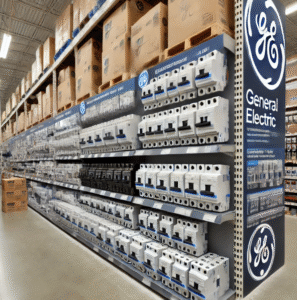
Retail runs on power—literally. From dazzling lighting that draws shoppers in, to point-of-sale (POS) terminals, refrigeration, HVAC, security cameras, and increasingly dense back-of-house tech, a store’s electricity is its lifeline. One silent component determines whether all of that stays dependable and safe: the circuit breaker. For many retailers, choosing General Electric (GE) breakers is a practical, long-term decision that protects people, preserves uptime, and keeps margins healthy.
The Business Case: Power Reliability Is Retail Revenue
Every minute a store is dark or a register is down is a minute of lost sales and shaken customer trust. Power interruptions cascade fast—freezers warm, lines form, and staff scramble to triage equipment. GE breakers are engineered to trip precisely when they’re supposed to and stay out of the way when they’re not, reducing nuisance trips that cause preventable downtime. In multi-circuit retail environments—from boutique footprints to big-box locations—the reliability of these protective devices translates into more consistent operations, steadier revenue, and a better shopping experience.
That reliability also matters across fleets. National and regional retailers need consistent protective gear from store to store so facilities teams, vendors, and electricians can work faster with fewer errors. Standardizing on a widely supported breaker family streamlines maintenance, replacement, and training—compounding savings across a portfolio.
Safety First: Protecting People, Equipment, and Inventory
Modern retail is dense with electronics: LED drivers, POS systems, touchscreens, Wi-Fi access points, self-checkout kiosks, digital signage, and refrigeration controllers. GE breakers help create a layered safety posture:
-
Thermal-magnetic protection to guard branch circuits from overloads and short circuits.
-
Ground-fault and arc-fault options (where applicable) to mitigate the kinds of faults that lead to shocks, equipment damage, or fires in busy public spaces.
-
Selective coordination when used with compatible upstream devices, helping ensure only the affected circuit trips rather than plunging a whole department—or the whole store—into darkness.
When a breaker performs predictably in a fault, staff and customers are safer, and valuable equipment—from compressors to registers—avoids catastrophic damage. That’s risk management with direct financial impact.
Speed and Simplicity: Maintenance That Doesn’t Disrupt the Floor
Retail thrives on predictability. When a breaker needs replacement, facilities teams want it done fast and right the first time. GE’s extensive distribution footprint, clear labeling, and compatibility within product families help technicians identify, source, and swap components quickly. In practical terms, that means:
-
Less time with ladders in aisles or lifts in vestibules.
-
Fewer after-hours service calls.
-
Streamlined work orders for store managers and corporate facilities.
For retailers managing hundreds of locations, this “everyday efficiency” rolls up into meaningful cost avoidance and fewer operational headaches.
Scalability for Rollouts, Remodels, and New Concepts
Retail doesn’t sit still—seasonal resets, remodels, pop-ups, and rebrands all put stress on electrical systems. GE breakers fit into modular approaches to panel design and circuit expansion, making it easier to add new loads (like self-checkout banks or refrigerated endcaps) without reworking the entire distribution strategy. With consistent breaker families and accessories, electrical contractors can plan upgrades that slot neatly into existing gear, shortening project timelines and keeping stores open.
Energy and Sustainability Wins Without Compromising Safety
Efficient operations are now a brand standard. As retailers adopt LED retrofits, smarter HVAC strategies, and energy-aware controls, electrical protection has to keep up. GE breaker options that coordinate with metering, surge protection, and downstream controls support:
-
Cleaner power for sensitive electronics.
-
Lower maintenance on lighting and refrigeration due to fewer transient events.
-
Better measurement and verification when paired with metering—so energy projects can be proven and scaled.
Sustainability isn’t only about utility bills; it’s also about making equipment last longer and avoiding wasteful failures. Breakers that trip appropriately and coordinate with upstream devices help preserve expensive assets.
Code Confidence: Built for Inspection and Compliance
Inspections are part of retail reality—especially for new builds and remodels on tight schedules. Breakers that meet prevailing standards and are backed by comprehensive documentation help keep projects moving. GE’s long history in power distribution gives specifiers and inspectors confidence in listings, short-circuit ratings, and coordination data. For retail leaders, that means fewer surprise delays and smoother handoffs from construction to store operations.
Protection Tailored to Retail Loads
Not all circuits are the same. Retailers benefit from aligning breaker choices with the quirks of each load:
-
Refrigeration and freezers: Inrush currents at compressor start-up can mimic faults to a lesser breaker. Choosing the right curve and rating minimizes nuisance trips that threaten inventory.
-
Lighting and signage: LED drivers can present harmonics or transient behavior. Robust protection helps keep front-of-house presentation pristine.
-
POS and IT racks: Sensitive electronics need stable power and fast fault clearing. Coordinated breakers and proper grounding reduce device failures and data-loss risk.
-
Back-of-house equipment: Balers, compactors, printers, and small conveyor motors benefit from properly sized protection that tolerates expected surges but reacts quickly to genuine faults.
Configuring protection thoughtfully with a reputable breaker platform reduces everyday frustrations and preserves the shopper experience.
Total Cost of Ownership: The Quiet ROI
Breakers aren’t a line item most retail executives obsess over—but they influence plenty of the ones that matter:
-
Fewer nuisance trips → fewer refunds, abandoned carts, and customer complaints.
-
Shorter service calls → lower lifetime maintenance spend.
-
Better asset protection → fewer replacement compressors, drivers, and registers.
-
Simplified training → store teams and vendors move faster and make fewer mistakes.
Across a chain, those quiet wins add up. Selecting a dependable, widely supported breaker family is a small, high-leverage decision.
Resilience for Omnichannel and Experiential Retail
Today’s stores operate as showrooms, micro-fulfillment hubs, and brand stages—all at once. That means more coolers, more screens, more scanners, more chargers, and more automation. Power incidents ripple further than ever. GE breakers, paired with sound panelboard design and surge protection, form the backbone of resilience for:
-
BOPIS and curbside pickup staging, where cold chain integrity and POS uptime are non-negotiable.
-
Experiential zones with lighting rigs, audio, and interactive displays that require stable power.
-
Back-room fulfillment tech (labelers, handhelds, RF chargers) that depends on clean, uninterrupted circuits.
Stable electrical protection sustains the omnichannel promise shoppers expect.
Supply Chain and Availability: Parts When and Where You Need Them
Retail moves fast, and facilities leaders need parts that are actually on shelves. GE breakers’ broad availability through electrical distributors means stores and service partners can get what they need quickly, reducing downtime when issues arise. That availability also simplifies capital planning: procurement teams can standardize SKUs and avoid long-tail, hard-to-source items that derail projects.
Future-Ready Infrastructure for What’s Next
From EV charging at the curb to smart shelves inside, retail electrification is accelerating. Breakers that integrate cleanly with evolving panelboard, metering, and surge protection ecosystems give retailers room to grow. Choosing a robust, well-documented platform now prevents costly rework later and creates a foundation for innovations that haven’t even hit the floor yet.
Reinforcing the Case with Industry Perspective
Strong electrical protection isn’t just a facilities topic; it intersects with broader industry priorities like operational resilience, customer experience, and loss prevention. To keep a finger on the pulse of how leading retailers think about store operations, resilience, and modernization, explore these authoritative resources:
-
Retail Dive for breaking developments in store operations and technology adoption across major brands.
-
National Retail Federation News for policy, operations, and resiliency insights affecting retailers of all sizes.
-
CNBC Retail for executive-level context on how operational investments (including infrastructure) influence sales, margins, and stock performance.
-
Retail (Wikipedia) for a high-level overview of the retail industry’s structure and evolving formats.
Each link offers context that reinforces why seemingly “back-room” decisions—like standardizing on GE breakers—show up on the sales floor as smoother operations, happier customers, and stronger financials.
Conclusion: Quiet Hardware, Loud Results 🏁
In retail, the best infrastructure is invisible to shoppers and invaluable to operators. General Electric breakers deliver predictable protection, broad availability, and portfolio-wide standardization that reduce downtime, safeguard people and assets, and keep the lights—and lanes—on. As stores take on new roles and technologies, dependable electrical protection becomes even more mission-critical. Investing in a trusted breaker platform is one of those quietly strategic choices that pays off day after day, transaction after transaction, across every aisle.